
Explainer · fairness testing
Nobody spins a reel. A number gets drawn and the reel follows.
Understanding that order of events explains most of what people get wrong about slot machines, and all of what a testing laboratory is there to check.
Mechanics
What the generator is doing
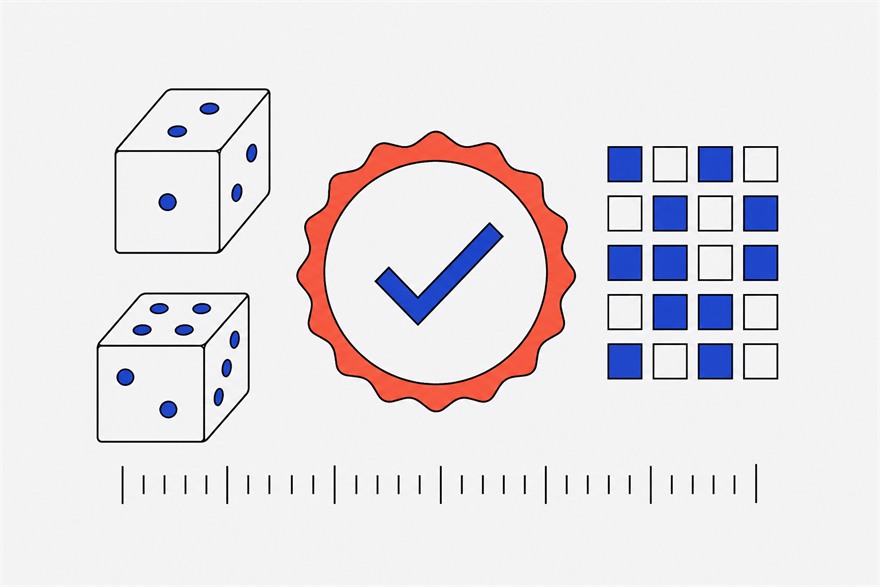
A random number generator in a casino game is a piece of software producing a long sequence of numbers that has no discernible pattern. Because software is deterministic, these are strictly pseudo-random: the generator starts from a seed value and each output follows from the internal state before it. Done properly, the sequence is statistically indistinguishable from true randomness over any practical run length, and knowing one output tells you nothing useful about the next.
The generator keeps running whether or not anyone is playing. When you press the button, the game takes the value available at that instant and maps it onto an outcome — a set of reel stop positions, a card from a shuffled deck, a number on a wheel. The visual spin is animation. The result was fixed the moment the value was drawn.
Why that ordering matters
It kills off most of the folklore in one go. A machine cannot be "due" a win, because the generator has no memory of what it produced earlier. Stopping the reels early changes nothing except how long you watch the animation. Autoplay produces the same distribution of outcomes as tapping manually. And because each draw is independent, a run of losses carries no information whatsoever about the next spin.
Who checks it
The independent test houses
A British-licensed operator cannot simply assert that its games are fair. The Gambling Commission's technical standards require game software to be tested by an approved independent test house before it goes live, and the Commission maintains the list of laboratories it accepts.
- GLI
- Gaming Laboratories International, one of the longest-established testing organisations in the sector, working across land-based and online gaming for regulators worldwide.
- BMM Testlabs
- Another long-standing independent laboratory, testing game software and platform components against the technical standards of individual jurisdictions.
- eCOGRA
- A London-based testing agency focused on online gambling, best known publicly for the certification seals that appear on operator and supplier sites.
- iTech Labs
- An accredited testing house specialising in random number generator evaluation and game fairness for online operators and content studios.
- Accreditation
- These laboratories typically hold accreditation to the international standard for testing and calibration laboratories, which is what makes their results acceptable to a regulator rather than merely a supplier's own word.
Where the game comes from
Testing happens at the studio that builds the game, not at the casino that hosts it. When you see NetEnt, Play'n GO, Pragmatic Play or Evolution named in our reference grid, that is the entity whose software was submitted for certification. An operator's job is to run the certified build without altering it — which is itself something the Commission's standards address.
The tests
What a certification report covers
A test house is not simply confirming that numbers look jumbled. The work splits into several distinct questions.
-
Statistical quality of the output
Standard batteries of tests are run against very large samples of generator output: frequency and chi-squared tests for uniform distribution, serial correlation tests for dependency between successive values, runs and gap tests for clustering, and equidistribution checks across the full range. Failure is not a matter of opinion — the results either fall inside the expected confidence intervals or they do not.
-
Correct use of the generator inside the game
A sound generator can still be wired up badly. Testers check that outputs are scaled to the game's range without introducing bias, that values are consumed in the intended order, that seeding is unpredictable, and that no part of the game reuses a value it should have discarded.
-
Return to player against the mathematical model
The studio submits the maths behind the game, and the laboratory verifies that simulated play over an enormous number of rounds converges on the stated theoretical return. This is where a published RTP figure gets its authority.
-
Accuracy of what the game tells you
Paytables, help screens and the displayed RTP have to match the certified behaviour. British rules require the return-to-player information to be available to the player, and a game whose help screen contradicts its maths fails on that basis alone.
-
Live dealer equipment and capture
Live tables are physically random, so the focus shifts. Testing covers the wheels, shoes and shufflers themselves, the optical recognition system that reads results from the table, and the reconciliation between what the camera sees and what the platform records.
RTP, honestly
What the percentage does and does not promise
Return to player is the proportion of all stakes a game is designed to pay back across an enormous number of rounds — typically millions in the simulation used to verify it. A figure of 96% means the theoretical model returns 96p per pound staked over that horizon, and that the remaining 4p is the house edge. It is a property of the game, not a forecast for your afternoon.
Session results scatter widely around that line, and the higher a game's volatility the wider the scatter. A high-volatility slot with a 96% return can pay nothing at all for hundreds of spins and remain entirely within its designed behaviour. Nothing has malfunctioned; you are simply looking at a short sample of a long-run average.
The detail most people miss
Some slots ship in more than one RTP configuration, and the operator chooses which build to deploy. Two casinos can therefore host what looks like the same game at meaningfully different theoretical returns. The figure shown in the game's own information screen is the one that applies where you are playing, which is a good reason to open that screen rather than rely on a number quoted elsewhere.
Worth being blunt about the conclusion: because the edge is built into the maths and verified as part of certification, no licensed casino game is designed to return more than it takes. Fairness testing confirms the game behaves as described. It does not make gambling a way to make money, and it never could.
Myths
Four claims the testing process rules out
-
"That machine is hot — it has been paying all morning."
Each draw is independent, so the generator has no state that could make a game generous for a period and stingy afterwards. What people are describing is a cluster, and clusters are exactly what genuinely random sequences produce. A sequence with no clusters at all would be the suspicious one, and it would fail a runs test.
-
"Bigger stakes trigger better outcomes."
The mapping from generator output to result does not consult your stake. Where two players see different theoretical returns, it is because the operator deployed a different RTP configuration of the game, not because the software reacted to the size of a bet.
-
"There is a system for beating roulette."
Staking systems change the shape of your results — a Martingale progression trades many small wins for occasional very large losses — but they cannot alter the probability of any single spin or the house edge attached to it. The wheel does not know what you staked last time.
-
"The casino can adjust the game when you are winning."
Under the Commission's technical standards, an operator runs the certified build; changing the maths of a live game is not a switch available to customer-facing staff, and altering a certified game without resubmitting it is a licence problem rather than a clever tactic. If you doubt a specific result, the operator has to give you a route to complain and, if that fails, to an approved dispute resolution body.
Jackpot Draft is an independent comparison site. It is not a gambling operator, not a regulator, and not owned by or affiliated with any testing laboratory, game studio or brand mentioned here. No games are offered, no bets are accepted and no money is handled on this site. This page is general information, not technical or legal advice. Gambling is for over-18s only and outcomes are never guaranteed. Free confidential help is available from the National Gambling Helpline on 0808 8020 133.